
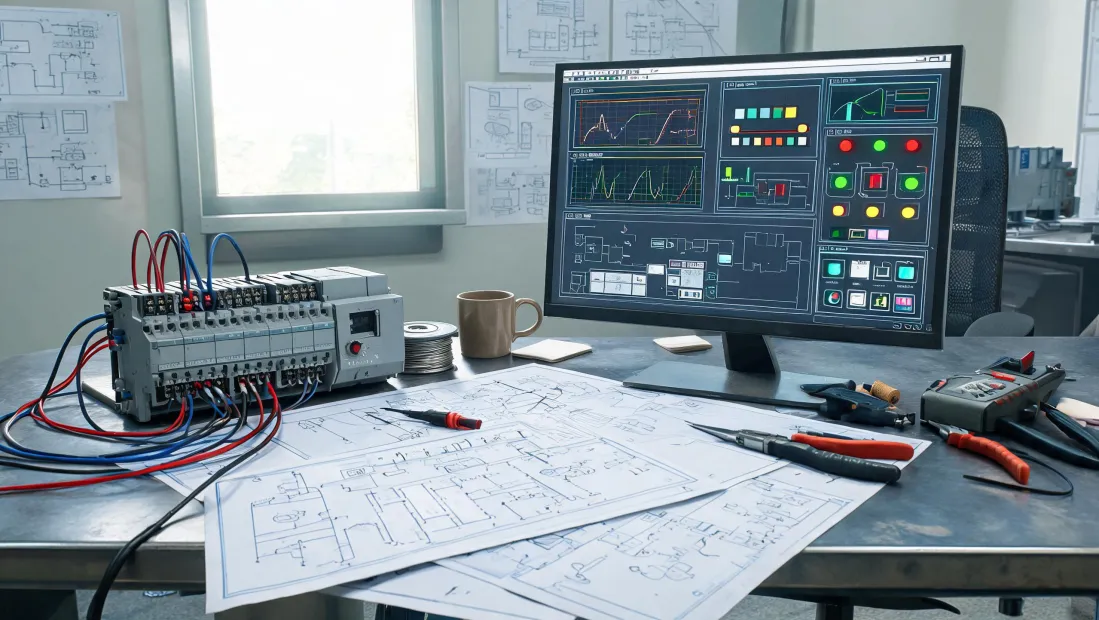
I've spent the last seven years managing procurement for a 120-person manufacturing company—roughly $180,000 a year in PLCs, contactors, timers, and related automation gear. I've negotiated with more than 25 vendors and tracked every order in our cost system. The pattern I keep seeing? The number on the quote is rarely the number you actually pay. So this article compares two ways of buying Omron PLCs and other industrial controls: authorized distributors who list transparent, all-in pricing, versus low-price suppliers who quote aggressively and add fees later.
The comparison framework is total cost of ownership, not unit price. Four dimensions matter to me: price transparency, product authenticity, technical support, and delivery reliability. Each one has a clear winner in a specific context—and the winner isn't always who you'd expect.
Dimension 1: Sticker Price vs. Actual Cost
Let's start with the obvious. In Q2 2024, we needed a batch of Omron PLCs for a line expansion. One supplier quoted $4,200—11% lower than the authorized distributor. Or so I thought. Their quote didn't include freight ($186), handling ($45), or a "priority processing" fee that applied to... every order, apparently. The authorized distributor's quote was $4,575 delivered, with every fee listed upfront and a freight estimate that matched what I'd expect. The low-price supplier's final invoice? $4,912.
I almost chose the cheaper option until I actually ran the numbers. The "cheap" quote ended up 14% MORE than the transparent one once everything landed.
Here's the thing: hidden fees are rarely accidental. When I audited our 2023 spending, the line items that quietly ate the budget weren't the high-ticket purchases. It was the $30 "processing fees" and $25 "environmental surcharges" that appeared on every invoice without ever being mentioned in the quote.
So my advice when evaluating an Omron PLC distributor: ask "What's NOT included?" before you ask "What's the price?" The vendor who lists all fees upfront—even if the total looks higher—usually costs less in the end. The same applies to contactor wholesale: a cheap per-unit price can hide minimum order fees, split-shipment charges, and restocking penalties that erase the savings.
Dimension 2: Authenticity and the Gray Market
This one surprised me. The surprise wasn't that gray-market Omron PLCs exist—it's how common they are, and how hard they are to spot until something fails.
I assumed "same model number" meant same factory specs and firmware. Didn't verify. Turned out the unit we received through a discount channel was a regional variant with different firmware. It worked fine for about four months. Then it started throwing unpredictable errors on a packaging line. When I called the supplier about the warranty, they pointed to a clause about "manufacturer defects" that somehow didn't cover a failed power supply.
Replacing that PLC cost $1,380. Plus two days of production downtime, which is considerably harder to quantify. Ask the supplier directly: can you trace this unit back to the PLC manufacturer with a serial number and production lot? If they hesitate, that's an answer in itself. The authorized distributor sent us that documentation without us asking twice.
The authorized distributor, by contrast, provided the serial number trace, the firmware history, and a warranty that actually responded. What I mean is that authenticity isn't a "nice to have" in industrial controls—it's risk management. Counterfeit or reconditioned PLCs might work fine for weeks, then fail at the worst possible moment. The cheap option is only cheap if it never fails.
That said, I should note: not every gray-market unit fails. Some are perfectly fine. But we don't buy components hoping they're "probably fine." We buy them expecting them to work, and we need someone to hold accountable if they don't. The transparency of that accountability—knowing exactly where your PLC came from—is worth something real.
Dimension 3: Support Is a Line Item You Don't See
Now, this is where I'll get a bit contrarian. Some procurement people argue you don't need distributor support if your engineers know what they're doing. Maybe. But I've seen enough projects stall over a missing manual, a compatibility question, or a software quirk to know better.
Two years ago, we switched part of our timer inventory to a new supplier. Their documentation was minimal. The timer worked—technically—but wiring it correctly required a phone call, a three-day email wait, and eventually finding the datasheet on a forum. That's not support; that's an obstacle course.
What to look for in a timer supplier is actually a good template for any component category. My short list: Do they publish complete specifications online? Can they answer a technical question without a multi-day email loop? Do their products have the certifications your application needs? Are their lead times realistic? You'd be surprised how many suppliers fail all four.
The authorized Omron PLC distributor we work with doesn't just sell hardware. They have engineers who know the product line, they answer programming questions, and when we needed a crash course on a new safety PLC, they pointed us to the right training. Nobody bills us for those conversations. That value never shows up on an invoice—but it shows up in our team not losing days to avoidable confusion.
Look, I'm not saying budget suppliers are always bad. I'm saying support is part of the product. If you're comparing a $5,000 PLC order across vendors, add an hour of your own team's time for every unanswered question. The math changes quickly.
Dimension 4: Delivery Promises Mean Something
Vendor said delivery would take a week. Did I believe them? Not entirely. Turned out they meant "production in a week"—ship date was day ten, plus three days transit.
We've all dealt with that. But there's a difference between the transparent distributors and the aggressive low-price suppliers: the transparent ones give realistic timelines and communicate when things slip. The others overpromise, then let you discover the delay when the shipment isn't there on Friday.
In 2023, a critical contactor wholesale order was delayed by two weeks. The supplier was apologetic, which didn't help the line waiting on parts. We had to expedite a partial shipment from another vendor—at 1.8 times the standard rate. Whatever we'd saved on that order evaporated in a single rush fee.
There's something satisfying about a supplier who says "we can deliver in 10 days" and actually delivers in 10 days. The best part of finally systematizing our vendor evaluation: no more 3am worry sessions about whether the order will arrive. (Should mention: we now build a three-day buffer into every critical order. That's probably the inventory planner's real lesson—but it still doesn't excuse phantom delivery dates.)
Which One Should You Choose?
I'm not going to tell you "the authorized distributor is always the answer." That would be lazy. The right choice depends on what you're buying and why.
Go with a transparent, authorized distributor when:
- You're buying PLCs for critical or continuous operation. The cost of failure dwarfs the price difference.
- You need warranty support, documentation, or technical guidance.
- You're routinely ordering contactors, timers, and other components—consistency matters more than a one-off saving.
A low-price supplier can make sense when:
- You're buying a non-critical component with a known track record and verifiable authenticity.
- The order is one-time, and you've checked serial numbers or batch documentation.
- The TCO spreadsheet—done honestly—actually shows savings after all fees and risks.
My procurement policy now requires quotes from three vendors minimum, and every quote runs through a TCO calculator I built after getting burned twice. That "free setup" offer cost us $450 more in hidden fees. And saving $80 by skipping expedited shipping? It cost us $400 when the standard delivery missed our deadline.
Per FTC guidelines (ftc.gov), advertising claims should be truthful and substantiated. I think the same standard applies to supplier quotes. The vendor who tells you the full price upfront is easier to trust. In my experience, on a $4,200 order, the difference between transparent pricing and a teaser quote can be $700 or more. That's not margin. That's your budget leaking through fine print.
Am I saying every authorized distributor is perfect? No. I've dealt with authorized distributors who were slow and occasionally opaque too. But as a category, they have more to lose by hiding costs. The sales rep who expects your next quarterly order is more likely to give a straight answer than a supplier who's optimizing for a single transaction.
Build the TCO spreadsheet. Force the "what's NOT included" conversation. Buy with open eyes—whether that lands you with a full-service distributor or a lean, transparent alternative channel, at least you'll know exactly why you chose it.