
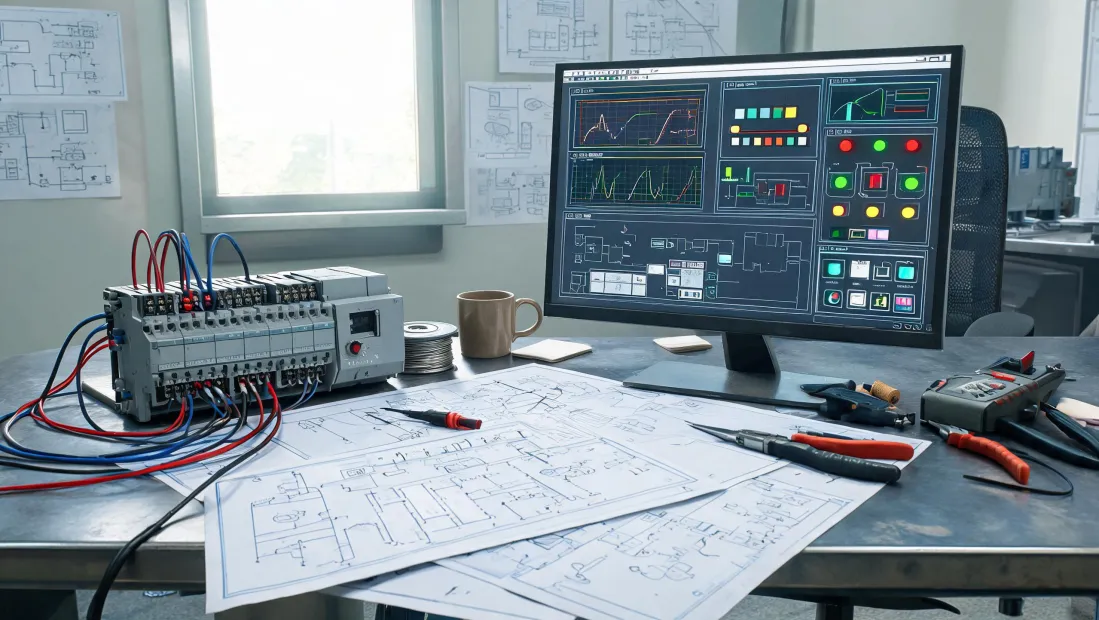
At 2:47 AM last October, I picked up the phone to a familiar voice.
A plant manager in Ohio. Packaging line down. Omron PLC alarm solid red, HMI stuck on a fault screen he couldn't clear. His biggest customer's trailer was due at the loading dock before sunrise, and he'd already done the obvious things: cycled power, swapped the HMI cable, reseated every connector he could reach.
'I need a PLC,' he said. 'What can you have at my door by 6 AM?'
I've taken some version of that call for the better part of eight years—more than 200 emergency orders, most with deadlines measured in hours, not days. And here's the part that still surprises people on the other end of the line: usually, the PLC doesn't need replacing.
The Part Nobody Bench-Tests
It's easy to see why the PLC takes the blame. It's the visible brain of the machine. It's flashing, it's stopping the line, and the alarm screen tells you everything except what actually broke. But when the 'dead' unit finally reaches a test bench, it has a habit of waking up. We've lost count of the Omron CP1H and CJ2 units, plus the newer NJ/NX controllers, that arrived tagged 'failed' and then booted up clean—program intact, every I/O point responding.
A controller like that wasn't dead. It was doing exactly what it was designed to do: sense something going wrong downstream and make a safe stop before the machine could damage itself. The red alarm wasn't a confession of failure. It was an indictment of something else in the same cabinet.
The Real Failure Is Usually a Few Inches Away
A lot of buyers assume a machine stops because the PLC failed. After enough of these calls, I'm convinced it's often the other way around: a peripheral component fails first, the PLC detects it and halts the process, and the PLC gets blamed because it's the component wired to the alarm.
That instinct isn't a coincidence. The 'check the PLC first' habit comes from an era when the controller really was the most likely thing to fail in the panel. Today, the controller is often the most reliable component in the cabinet. The real weak point is the relay cycling eighty times a minute, or the contactor bolted a few inches from a VFD's heat sink. They degrade gradually, invisibly, until one cycle crosses the line—usually the day before a deadline, because industrial time has a sense of humor.
The coil is doing the dying
Every relay and contactor contains a coil, and a coil is an inductive load. Each time it switches, it throws a voltage spike back into the circuit. Good components are built to survive that, and good control panels add suppression where needed. Components engineered to a price point often skip the extras, and their coil insulation degrades a little on every cycle until, one day, the coil opens in the middle of a critical run.
The PLC sees the feedback that never arrived, or the current that never stopped, and it stops the line. The PLC didn't quit. The dying coil took the circuit down with it.
Same amp rating, different capability
Contactors carry misleadingly simple nameplates. A contactor rated 25 amps for a resistive load is not the same as one rated 25 amps for motor starting. Motor loads draw several times their running current on close, so the contacts wear differently. If your supplier quotes a generic amp number without telling you the load category, you are selecting a component without its most important spec. In IEC 60947-4-1 terms, motor duty is AC-3, resistive heating is AC-1, and the two are not interchangeable.
Private label isn't the enemy—hidden sourcing is
I don't want to sound like someone who reflexively opposes relay private label. Some of the best components on the market run under names you've never heard of. But private label becomes a gamble when the buyer can't find out who actually made a batch, or when the factory changes between orders. When the source is hidden, the only thing left to compare is price—and the machine eventually pays the difference.
There's been plenty of Omron PLC news recently, and the big story is the shift from the older CJ/CS family toward the Sysmac NJ/NX generation. But no platform change alters the basic physics: a PLC executes logic and reports faults. It cannot compensate for a contactor that was marginal from day one.
The $400 Saving That Cost $9,600
This is the part of the conversation where budgets get uncomfortable.
I remember a plant that switched relay suppliers because the private-label quote was about $400 cheaper per batch. Twelve weeks later, one of those relays welded closed on a Friday afternoon. The machine kept cycling with a component out of position until something broke that shouldn't have broken. The repair bill was roughly $9,000, plus a $600 expedite fee for the replacement part, plus twenty-two hours of downtime on a line that billed far more than that per hour. The $400 saving was real. It was also the most expensive $400 that plant spent all year.
When I'm triaging a rush order, the freight isn't the hard part. Trucks can move fast. What's hard is the conversation after the panic settles—the one where we find out the original component had been failing for weeks and nobody had looked at it.
The plant manager from October didn't end up buying a PLC. We walked through the diagnostic buffer, found which axis faulted first, traced it upstream to the contactor feeding it, and found a burned terminal on the coil. He replaced a $60 contactor, and the line was running by 5:30 AM, before that trailer arrived. The Omron PLC that was almost replaced is still in that cabinet today.
How to Evaluate Contactor Manufacturers Before You Need Them
I've turned that experience into a checklist for clients who are standardizing control components now, so they don't get a 2 AM call later:
- Ask who actually built it. A supplier that can name the factory behind its private-label components is showing you its supply chain is controlled. If the answer gets vague, treat that as an answer.
- Read the datasheet, not the brochure. Look for coil operating limits, ambient temperature range, and electrical endurance at your expected load. If those numbers aren't published, ask for them. If they can't be produced, that's a red flag.
- Match the duty rating to the application. For motor loads, the contactor should be rated for AC-3 duty per IEC 60947-4-1, not given a generic amp rating that implies more capability than it has.
- Check the coil specs before you trust the price. A coil that drops out during a voltage dip or sends an unsuppressed spike back into the PLC output will create intermittent faults that are nearly impossible to track down.
- Buy through a contactor distributor who can trace the batch. Knowing which lot your components came from—and being able to pull the test documentation—matters enormously when a pattern of failures shows up in service.
- Cycle a sample before you standardize. Put a candidate relay or contactor on a bench with a realistic load, switch it a thousand times, and feel the case temperature. The difference between a quality component and a marginal one becomes obvious very quickly.
I'll also say this plainly, because 'we do everything' is how suppliers burn their credibility: our lane is components and speed. If you're designing a completely new production line and you need deep application engineering, you should be working with a system integrator who specializes in your industry. That's not our job, and I'd rather tell you that before your deadline is on the line. But when a control component fails in the field and the clock is ticking, that's the problem we work on every single day.
So before you order a thousand-dollar replacement PLC, take a breath. Check the alarm log for the first fault event, not the last one. Look downstream of the controller before you blame it. The brain is often innocent—and the fix might already be in your maintenance stockroom.