
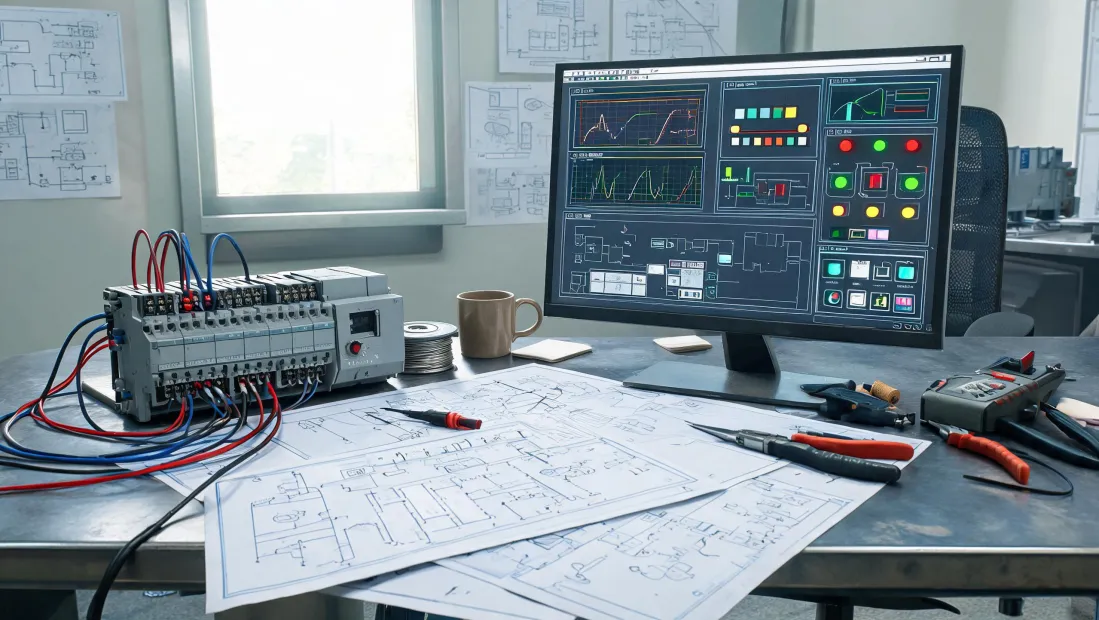
March 2024, 7:40 a.m. A panel builder I supply called with the kind of news nobody wants before their first coffee: 41 field failures out of a 600-unit run. The units were gate controllers, each shipped with a 12V 1Amp power supply in the box. The controllers were not dead. They were rebooting at random intervals, which is worse — random failures generate service calls, and service calls generate arguments.
Everybody's first guess was counterfeit stock. Mine too. It took about two hours on the bench to prove we were both looking in the wrong place. The 12V 1Amp power supplies were exactly what the label claimed. They just were not what the application needed, and the gap between those two things is where most of my adapter and charger problems live.
What everybody blames first
When a 5V 3A power adapter or a 9V 1A adapter fails in the field, the post-mortem usually lands on one of three suspects: the brand, the price, or a fake certification mark. All three can be real problems. In the roughly 300 adapter and charger orders I have handled over 11 years, they have been the minority. The ones that actually hurt came from something duller — a specification that described a lab condition, not a factory floor.
The deeper problem: a nameplate is a best case, not a promise
3 amps is not 3 amps everywhere
A 5V 3A power adapter is rated at 3A under specific conditions: 25°C ambient, at the output connector, after thermal stabilization, with free airflow around the case. Put that same unit inside a sealed enclosure on a plant floor running at 45–50°C and the honest continuous rating is probably closer to 2.1–2.4A. The derating curve that tells you this is usually on page four of the datasheet, in a chart most buyers never open.
I opened it in 2022, after a different failure, and found the number I needed sitting there the whole time. That was a $2,800 lesson about reading charts.
The adapter is fine. The cable is eating your volts.
This is the one that surprises people, and it is the one I now check first. Voltage drop is a cable and connector problem, not an adapter problem.
24 AWG copper runs about 0.084 Ω per meter per conductor; the return path doubles it, so figure roughly 0.17 Ω per meter of cable. A 2-meter lead gives you about 0.34 Ω of loop resistance. At 1A, that is 0.34V gone before the load sees anything. At 3A it is closer to 1V — and that is before connector contact resistance gets involved.
So a 12V 1Amp power supply with a long thin lead delivers something closer to 11.6V at the barrel jack. If the device brownout threshold is 11.4V, you have 0.2V of margin on a good day at room temperature. Run the same numbers on a 5V 3A power adapter with undersized leads and you can lose more than a volt, which is why devices reset at random — they reset when the compressor next door kicks on and the input sags below threshold.
(Note to self: put loop resistance in the RFQ template. It has been on my list for a year.)
UL adapter is a phrase, not a certificate
UL marks are scoped to a file number and a model list. A quotation line that says UL with no file number attached is a claim, not evidence — and if your customer audits you later, telling them we were told it was UL is not going to be a satisfying answer.
There is also a difference between UL Listed and UL Recognized Component. A recognized component is evaluated for use inside a final product; it does not automatically make the assembly you build around it compliant.
I am not a compliance engineer, so I cannot speak to how the standards apply to your specific end product. What I can tell you from the supply side: UL 60950-1 was withdrawn in the U.S. in July 2020, and much of this equipment now falls under UL 62368-1 — but confirm the applicable standard with your compliance team rather than a supplier sales sheet. Ask for the E-number. Confirm your exact model appears in that file. And if a vendor markets a certification claim hard, remember that the FTC requires advertising claims to be truthful and substantiated; an uncorroborated UL listing line is exactly the kind of claim that falls apart under scrutiny.
A travel power adapter does not change volts
This one cost me a customer relationship. A travel power adapter changes the shape of the plug. That is all it does. It does not step 230V down to 120V, and it does not protect anything downstream.
A vendor sent a 9V 1A power adapter rated for 120V input only, and someone plugged it into a 230V socket using a travel power adapter. The result was a pop, a smell, and a very awkward phone call. Plenty of modern supplies are genuinely 100–240V input and travel fine — but check the input range printed on the case, not the plug shape. Then check what is downstream, because the barrel jack does not know what continent it is on.
Industrial battery chargers fail on profile, not voltage
With industrial battery chargers, the voltage almost always matches the spec. The charge profile does not. Bulk, absorption and float stages, temperature compensation, and the difference between flooded lead-acid and AGM settings decide whether a bank lasts five years or eighteen months. A charger configured for flooded lead-acid on an AGM bank will quietly cook it. U.S. industrial battery chargers are typically evaluated under standards such as UL 1564, and the profile settings matter as much as the listing.
Matching volts and amps is the easy 20% of the specification. The profile is the other 80%, and it rarely makes it onto a purchase order.
The line items nobody quotes
Here is where I will be blunt: the quote that looks cheaper usually is not. What it excludes is the test report, the E-number documentation, country-of-origin paperwork, the MOQ overage, the retooling fee if you change the cable length, and the duty that shows up three weeks later.
I have learned to ask what is not included before I ask what the price is. A vendor who lists every fee up front — even when the total looks higher — has usually cost us less by the time the last invoice lands.
As a sanity check, publicly listed B2B pricing for a 5V 3A power adapter (Level VI, certified, 1,000-unit MOQ) tends to sit somewhere around $3.50–$7.00 per unit, with a 12V 1Amp power supply around $2.80–$5.50, as of early 2026. Treat those as ballparks, not quotes. Copper, tariffs and MOQ move the number more than any vendor sales sheet admits.
What this actually costs
Back to those 41 failures. The visible cost was field service labor, return freight, and 41 replacement units. The invisible cost was larger.
In March 2024, with 36 hours before a customer install window, we air-freighted 200 replacement supplies at roughly $800 in expedited freight to protect a $12,000 order. The freight hurt. What actually stung was the three weeks our client spent re-qualifying us as a supplier — and the two RFQs that quietly stopped arriving.
Once, in 2022, we lost a contract worth about $40,000 because we tried to save $0.22 per unit on a 9V 1A adapter by skipping the load test documentation. The buyer found the gap during their own audit. That is the moment I stopped treating test reports as paperwork.
The fix, short version
The problem is a specification problem, so the fix is a specification fix. Six checks, none of which take long:
- Derate by 25–30%. If the load draws 2A continuous, buy 3A minimum — and read the derating curve at your actual ambient temperature, not at 25°C.
- Specify the cable and the connector. Length, gauge and connector type are part of the power supply, not an accessory you can change later for free.
- Ask for the E-number and confirm your exact model appears in the file.
- Ask for a load test at temperature, not a bench test at room temperature.
- Burn in two samples at full load for eight hours before approving the batch.
- Ask what is not included. Certification documents, retest fees, MOQ, duty.
It is the same discipline that applies to DIN-rail supplies feeding a PLC panel. The controller input tolerance is a range, not a single number, and the supply has to hold the bottom of that range under full load on the hottest day of the year. Most of the time it will. That is not good enough when the alternative is 41 service calls.
My experience here is based on roughly 300 adapter and charger orders, mostly mid-volume B2B runs. If you are buying single units retail, or quantities in the tens of thousands with an in-house compliance team, the math changes. The specification mistakes do not.
None of the 41 failures were a brand problem. All of them were a page-four problem.