
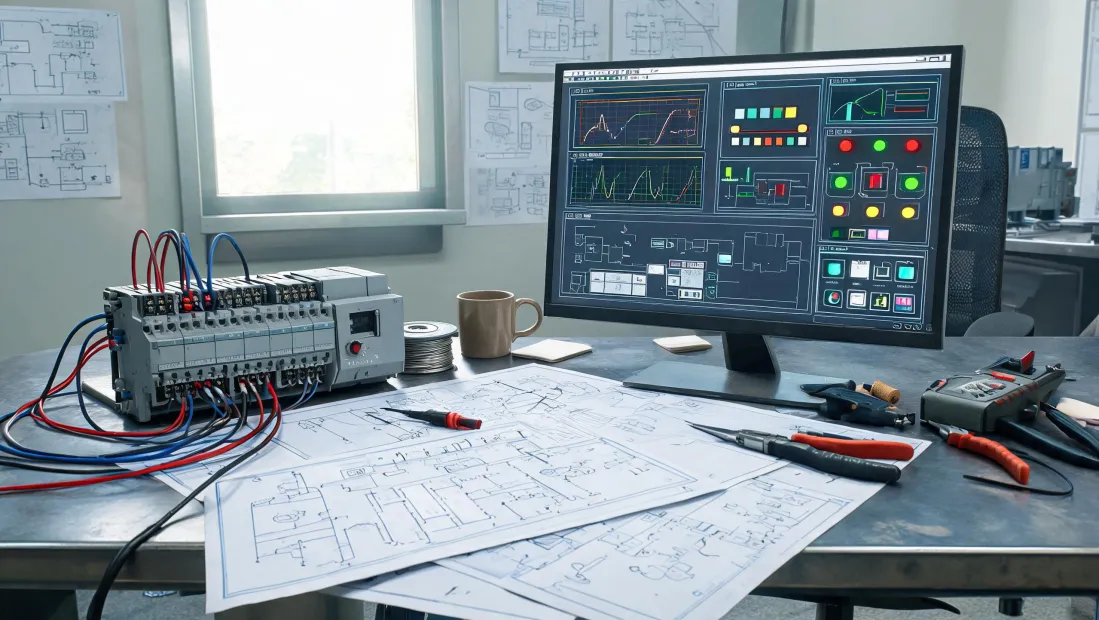
It was the second Thursday of March 2024. I was standing at a side entrance of a logistics hub with a torn drawing on the floor and a 200 amp panel in front of me that I already knew was going to be a problem.
Let me explain what I get paid for. I run quality and brand compliance at an industrial backup power company. Roughly 200 deliverables move through my desk each year, and in 2024 I rejected 23% of them on the first pass. My job isn't making them sound better. It's keeping the technical floor in a position that's actually defensible before something gets bolted to a customer's wall.
The customer was a regional logistics hub. The primary system on paper was fine. A 200 kVA Kohler-SDMO diesel unit, an automatic transfer switch at the 600 amp service entrance. The sizing was pretty solid—starting loads, nonlinear loads, a 30% derating margin, all of it was verified. On handover nothing about the primary side gave me a reason to worry.
But my process doesn't stop at the primary system. I pull at least one secondary panel on every project. The one I pulled that day was a 200 amp panel serving the office annex and the security building—separate structure, roughly 200 feet from the main plant.
The Panel That Didn't Match the Drawing
On the drawing, that panel called for a manual 50 amp generator transfer switch. On the actual installation, it had a mechanical interlock plate bolted onto the generator input breaker.
An interlock is basically a small piece of metal—a mechanical stop that keeps the generator input and the utility main from being in the on position at the same time. It's cheap. We're talking around $300, no separate cabinet, and an hour to install. Paired with a portable generator, it's code-compliant. In the right single-family residential installation, it's probably the correct choice.
A transfer switch—manual or automatic—transfers the load from one source to the other, and it also switches the neutral. That second part ended up being the whole argument.
Here's what was going on at that panel. It sat in a separate building. That building had its own grounding electrode. The panel's neutral ran back to the main switchgear. As installed, the neutral was effectively giving the generator circuit a parallel return path. Load went up, and some of the return current traveled on the neutral rather than through the designed ground-fault path. A fault that should have tripped protection ended up going into the earth.
I didn't piece that together right away. The contractor had 20 years of experience, and he told me, "We do it like this everywhere and we've never had a problem." I thought, maybe I'm overthinking this. I've seen plenty of panels sit for years with issues that never surfaced. I sent the photos up the chain that evening and almost let it go until the next morning.
The next morning my inspection engineer messaged me: "Where's the transfer switch on that panel? Is it somewhere else?" I told her it was on the portable inlet. She said, "That's a 13000 watt generator on a 50 amp inlet. That's 54 amps, isn't it?"
That was the number the whole office had missed. 13000 watts divided by 240 volts comes out to 54.2 amps. It was sitting on a 50 amp inlet and a 50 amp circuit. There's just 4 amps of overhead. On its own, that's not a serious problem with a portable generator—the unit can carry short overloads and the breaker will eventually trip—but the issue wasn't the margin. The issue was that the interlock wasn't switching the neutral at all.
That's when I stopped being polite about it. I had the contractor open the panel so we could see exactly what had been installed. The interlock was there on the generator input breaker. The spec sheet had clearly called for a manual 50 amp transfer switch. The contractor had swapped it to save time and a purchase order. The interlock was installed on a Saturday. My audit was Tuesday.
The Rework, and What It Actually Cost
We tore it out. Replaced it with a 50 amp transfer switch that switches the neutral, rewired it, retested, and relabeled the panel. The bill came to $2,400, absorbed on the tail end of the construction window, and it pushed delivery by nine days. The customer wasn't furious, but they weren't happy either. The contractor was also annoyed—from his perspective he'd been saving me time.
The lesson here isn't "interlocks are bad." Interlocks are great. Across the 200+ installs I've audited, I'd estimate maybe 80% of the cases where a contractor wants to use an interlock with a portable inlet are actually fine—residential, single structure, no complicated ground-fault path. The problem is the other 20%, and nobody wants to admit they're in it.
So the question "generator interlock vs transfer switch," in my opinion, is asked wrong. What you actually want to ask is: does this building have its own grounding electrode? Does the neutral need to be switched? And is this a system where a person is going to stand next to it and manually transfer, or does it need to switch itself?
If any one of those is "yes," skip the interlock.
For sites running a 200 kVA Kohler-SDMO class of machine, the answer is usually decided for you. A commercial system at that scale shouldn't be shopping for a $300 interlock. But honestly, the machine rarely ends up being the part that's broken. The design around it does.
Three Questions I Now Ask on Every Unit
Since then, I've added three questions to every Kohler-SDMO backup generator system I review:
- Where does this panel take its supply from, and where does it sit? If it's a subpanel downstream of the main switchgear, does the neutral actually run clean this time—switched, or bonded?
- What's the source side—fixed unit or portable? If it's portable, does its output actually cover the breaker it's wired into? (A 13000 watt generator on a 50 amp inlet doesn't leave a lot of headroom.)
- Is the system automatic, manual, or interlocked? And if it's manual, who's flipping it, and how often?
If I get an ambiguous answer on any of those three, I stop the job.
I won't pretend my review process was complete before that one. The checklist I use now has sections I didn't have in February. What shifted wasn't what I inspected; it was where I stood while inspecting it. I used to start with the primary system and walk through the rest in order. Now I stand 200 feet away from the main switchgear and ask the question from there. That's usually the position that tells you if what you're looking at is actually a backup power system or just a generator that's been paid for.
For what it's worth, the 13000 watt portable ended up fine. We kept it as a mobile backup unit with a proper inlet and a label that matched the breaker. What got replaced was the way it was plugged in—which, thinking about it, is basically every one of these cases I've reviewed. The unit was fine. The connection wasn't.
Note on code references: neutral-switching requirements for optional standby systems sit in the NEC's standby articles, but the specifics vary by AHJ and by the 2023/2024 code cycle. Verify with your local inspector before signing off on a subpanel that uses an interlock. I've gotten it wrong before, and I don't want you to.